

Slow-Fermented Hot Sauce: Why I Went Back to One Pepper (and Six Months)
After 26 years of making my own hot sauce, I’ve learned that the best batches come from the simplest recipe and a lot of patience. Here’s my long-ferment method, step by step.

Hidden Lake Hot Cayenne-Thai hybrid peppers on the plant
For the past several years, I’ve been fermenting a big mixed bag of peppers. Mild ones like jalapeño and serrano, medium ones like Aleppo and Fish peppers, and a few scorchers like habanero and Scotch bonnet. In theory, that sounds like a recipe for layers of complex flavor. In practice, the ferments got a little wild. Some batches came out oddly sweet. Others had a funk I can only describe as “dirty feet.” Neither one is a flavor I want to shake onto my eggs.
So this year, I went back to basics: one pepper, a longer ferment, and more patience. Last year’s version of this post covered the quick, two-to-four-week method. This one is the slow version, and after comparing the two for a couple of decades, I think it’s the better sauce.
Live and Learn: Why My Mixed-Pepper Ferments Went Sideways
Fermentation is a group project. The Lactobacillus bacteria you want are competing with wild yeasts and other microbes for the sugars in the peppers. When everything’s balanced, the lacto bacteria win, the brine sours, and you get that clean, tangy flavor that makes Frank’s and Tabasco taste the way they do.
Throw a dozen pepper varieties in the jar, and you’re changing the balance in a few ways:
- Different sugar loads. Fruity peppers like habaneros and Scotch bonnets carry more natural sugar than a lean cayenne-type pepper. Extra sugar gives wild yeasts more to eat. Yeasts make alcohol and fruity compounds, not the lactic acid you’re after, and that’s where the odd sweetness comes from.
- Different skins, walls, and ripeness. Thick-walled jalapeños, thin-skinned Thai types, and wrinkly Aleppos all break down at different speeds, so the jar is never really fermenting “one thing.”
- More room for off-flavors. When the good bacteria don’t take over quickly, other microbes get a foothold. Some produce compounds like butyric and isovaleric acids. Isovaleric acid is the same compound behind the smell of sweaty socks, so “dirty feet” is more literal than it sounds.
None of this made the sauce unsafe. The salt and acid still did their jobs. But it made every batch a coin toss, and after 26 years I’d rather have a sauce I know I’ll love.
Meet “Hidden Lake Hot”: My Homegrown Hot Sauce Pepper

Fresh picked HLH peppers for the ferementer
The pepper I went back to is one I’ve been growing for decades, a Cayenne–Thai cross I developed here and call Hidden Lake Hot, or HLH for short. I’ve saved seed from the best plants year after year, and it’s become my all-purpose pepper. It dries beautifully, it’s great fresh, and it has just the right amount of heat: enough to get your attention without blowing out your taste buds.
Most importantly, it ferments like a dream. The thin walls and lean flesh break down evenly, the sugar is modest, and a long ferment brings out a savory, slightly smoky complexity that I’ve never gotten from a mixed jar.
It has one more big advantage here in San Diego: HLH keeps flowering and fruiting well into December. Instead of picking everything at once, I can harvest a fresh batch every week and keep feeding the jar for months. That’s what makes the long-ferment method below possible.
Don’t have HLH? No problem. The method works with any single pepper variety, or a blend of two similar peppers (think cayenne and Thai, or cayenne and Tabasco). Pick peppers with similar heat, thin walls, and not too much fruity sweetness, and stick with them all season.
The Long-Ferment Timeline
Here’s what six months of hot sauce looks like on the calendar:
| When | What’s Happening |
|---|---|
| Late Sept – mid-Dec | Start the jar, then add 8–16 oz of fresh peppers every week for about 12 weeks |
| Mid-Dec – late Feb | Move the fermenter to a cool spot (my garage) and let it rest through the winter |
| Late Feb – early March | Blend, add vinegar, strain, reduce, and bottle |
| April | Let the bottles age another month, then crack one open |
Six months sounds like a long time to wait for hot sauce, I know. But most of that is waiting, not working. And the payoff is a sauce that tastes the same from the first bottle to the last.
Equipment & Ingredients
Equipment
- Glass jar or fermentation crock (I start with a 1-gallon jar). Glass, ceramic, or food-grade plastic all work. Just avoid metal, which reacts with the acidic brine.
- Pickling weight. A glass fermentation weight, or a zip-top bag filled with brine (not plain water, in case it leaks).
- Airlock lid (strongly recommended). For a two-week ferment, a regular lid you burp every few days works fine. For a six-month ferment, an airlock lets gas escape without letting air in, which keeps Kahm yeast and mold down.
- Blender or stick blender.
- Fine mesh sieve or cheesecloth.
- pH test strips or an inexpensive pH meter. Optional, but nice to have at bottling time.
Ingredients
- Hot peppers: About 1 lb to start, plus 8–16 oz per week after that
- Kosher salt: 3 Tbsp per quart of water (2 Tbsp if you’re using fine table or pickling salt)
- Chlorine-free water: Distilled, filtered, or tap water that’s been boiled or left out for 24 hours
- White or cider vinegar: For bottling day
How to Make Slow-Fermented Hot Sauce
Step 1) Make the brine
Stir 3 Tbsp of kosher salt into each quart of water until it’s completely dissolved. Make an extra quart and keep it in the fridge, because you’ll be topping off the jar every time you add peppers.
Step 2) Start the jar
Wash your first pound of peppers, trim off the stems, and pack them into the jar. No need to slice them or remove the seeds. Pour in enough brine to cover them completely, tap the jar to knock out air bubbles, and set your weight on top so everything stays submerged. Seal it with the airlock lid.
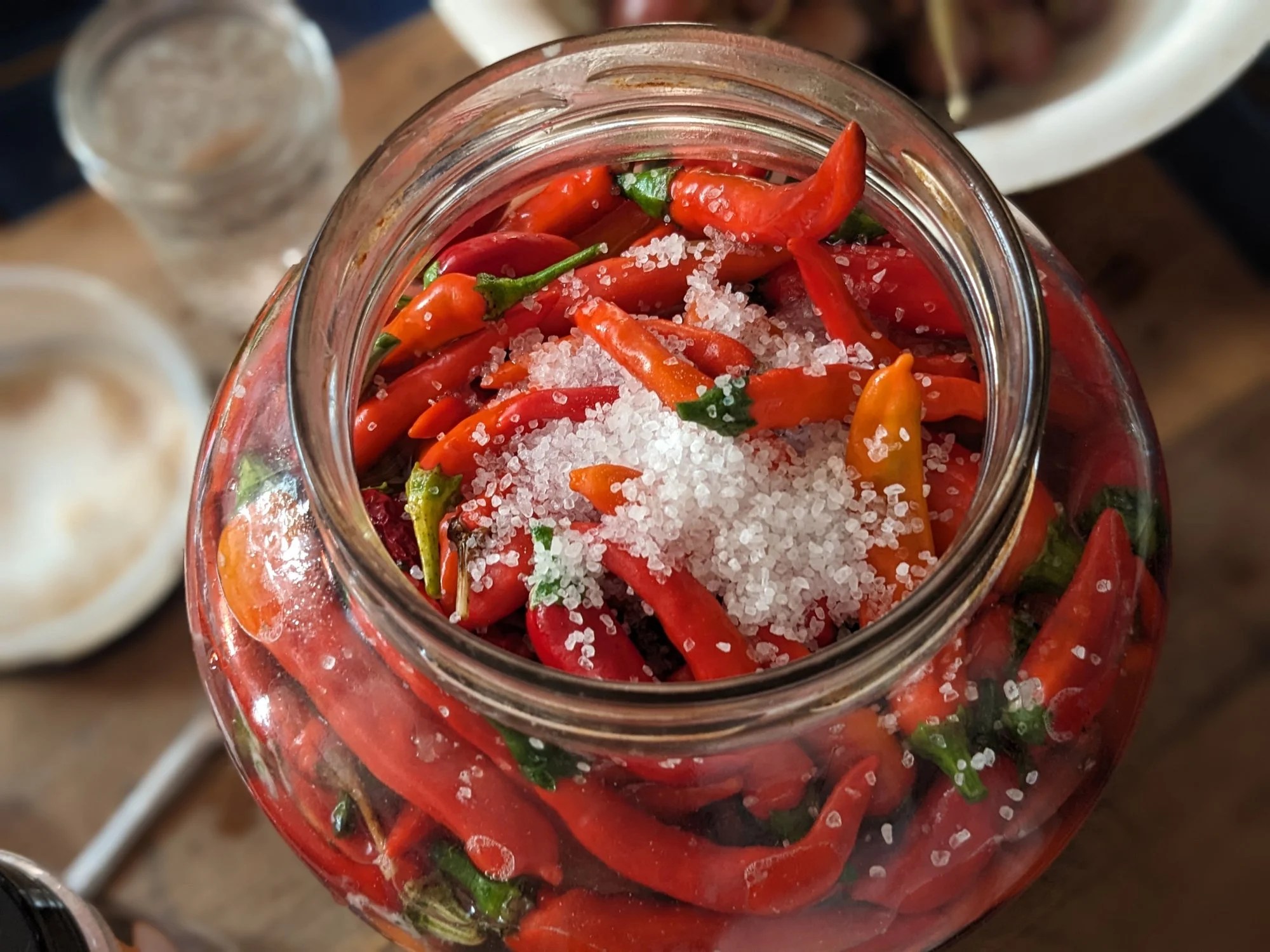
Starting the peppers with a little salt and chlorine-free water
Step 3) Let it get going
Keep the jar at room temperature, out of direct sunlight. Somewhere between 65°F and 80°F is ideal. Within a week or so, the brine should turn cloudy, bubble occasionally, and smell pleasantly sour. That’s the Lactobacillus taking over.
Step 4) Feed the jar every week
Once the ferment is active, add 8–16 oz of freshly washed peppers each week. Here’s how I do it:
- Wash your hands and any tools you’ll use. Every time you open the jar, you’re letting in air and wild yeast, so keep it clean and quick.
- Lift out the weight and push the new peppers down into the brine.
- Top off with your extra brine at the same 3 Tbsp per quart ratio. Adding plain water dilutes the salt, which gives the unwanted microbes an opening.
- Put the weight back, make sure everything’s submerged, and seal it up.
Here’s a nice bonus of the rolling method: each new batch of peppers drops into brine that’s already sour and full of the good bacteria. The established ferment gives the newcomers a head start and helps crowd out the troublemakers, which is a big reason the flavor stays consistent.
Running out of room? If your jar fills up before the peppers stop coming, just transfer everything (peppers, brine, and all) into a larger container and keep going. I move mine into an old 5-gallon homebrew bucket, but any bigger glass jar, crock, or food-grade bucket will do.
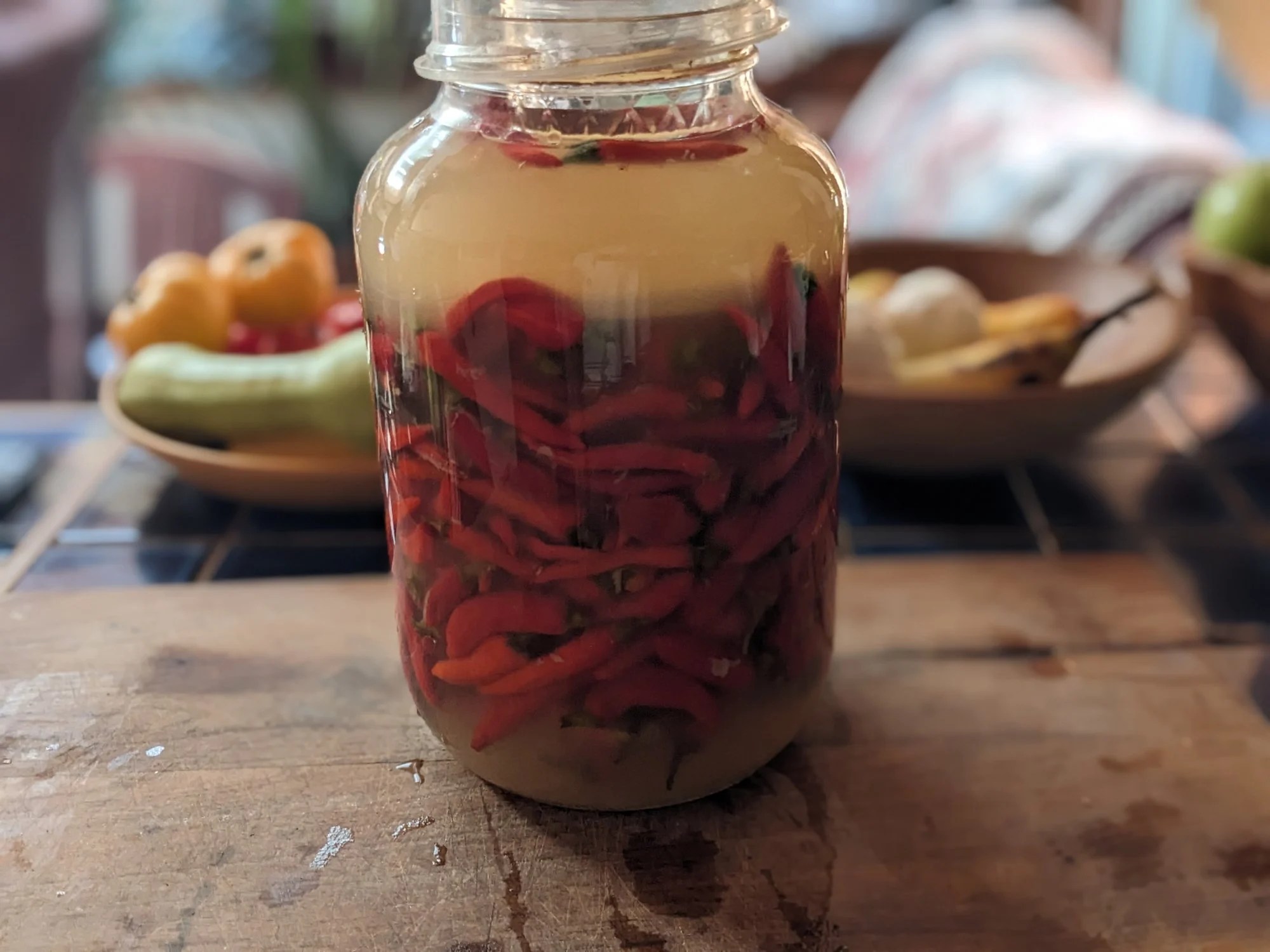
Fermenting peppers after week 3’s addition
Step 5) Let it rest through the winter
When the plants finally slow down (for me, that’s usually mid-December), I make one last addition, then move my fermenter to a cool spot in the garage. In San Diego, winter garage temperatures hover in the 50s and low 60s, which is perfect. At that temperature, fermentation slows way down, and the sauce spends the next couple of months quietly mellowing and developing flavor.
Check it every couple of weeks. If you see a flat, white film on top, that’s Kahm yeast. It’s harmless, so just skim it off. If you see anything fuzzy, or blue, green, black, or pink, that’s mold. Throw the batch out and start over. It’s rare with an airlock and a good weight, but over a six-month ferment it’s worth keeping an eye on.
Step 6) Blend, strain, and bottle (late February to early March)
- Pour the peppers and brine into a large pot and blend them until smooth with a stick blender (or use a regular blender, then pour into the pot).
- Stir in vinegar at a 1-to-1 ratio with the pepper mash.
- Press the mixture through a fine sieve or cheesecloth to remove the seeds and pulp.
- Warm the sauce gently over low heat to cook off some of the water, until it’s about the consistency of Frank’s or Tabasco.
- Funnel it into clean bottles and cap them.
If you have pH strips, now’s a good time to use them. A finished sauce should read 4.0 or lower. Between the fermentation and the vinegar, yours will almost certainly come in well under that.

Use a mesh strainer or cheesecloth to remove the seeds and pepper pulp
Step 7) Age it one more month
Here’s the hardest part: store the bottles in a cool, dark place and leave them alone for about a month. This lets the vinegar and ferment blend into one smooth, tangy flavor instead of tasting like two separate things. Once you open a bottle, it’ll keep at room temperature for months, though I keep mine in the fridge to hold the color and heat longer.

Fresh bottles of slow fermented hot sauce ready to age for another month
Is a 6-Month Ferment Really Worth It?
After 26 years of making it both ways, my answer is yes. The quick two-to-four-week method from last year makes a perfectly good hot sauce, and it’s a great place to start if you’ve never fermented peppers before. But the slow version is where the sauce gets its depth. The heat and the tang are balanced, the flavor is more savory than sweet, and every bottle tastes like the last one.
Tabasco reportedly ages its pepper mash for up to three years, so six months is practically fast food.
Safety & Troubleshooting FAQs
Is a long ferment safe? What about botulism?
Yes. The salt keeps harmful bacteria in check while the lacto bacteria get established. Once they do, the brine becomes acidic enough that botulism can’t grow (that bacterium needs a pH above 4.6). The vinegar you add on bottling day pushes the acidity even further into the safe zone.
Can I really keep adding fresh peppers to a jar that’s already fermenting?
Yes, as long as you keep everything submerged and top off with brine at the same salt ratio. The established, acidic ferment actually protects the new peppers.
My ferment slowed way down in the garage. Is that a problem?
Nope, that’s the point. Cool temperatures slow the microbes down so the flavors can mellow. It’ll pick right back up if the weather warms.
There’s white film on top. Is it mold?
A flat, white film is Kahm yeast, which is harmless, so just skim it off. Fuzzy growth, or anything colored, is mold. Toss the batch.
How do I know it’s ready to bottle?
The bubbling has stopped, the brine is cloudy, and it smells clean and sour, like sauerkraut or sourdough starter. If you have pH strips, the brine should read 4.0 or lower.
Is this your first time fermenting hot sauce? Start with last year’s quick-ferment guide, then graduate to the long version next fall. And if you’ve ever had a ferment go sideways, I’d love to hear about it in the comments. I’ve got a few “dirty feet” stories of my own.
You Might Also Like These


About the Author: Sage Osterfeld


